Wednesday, 6 February 2013

Liang Shaoji

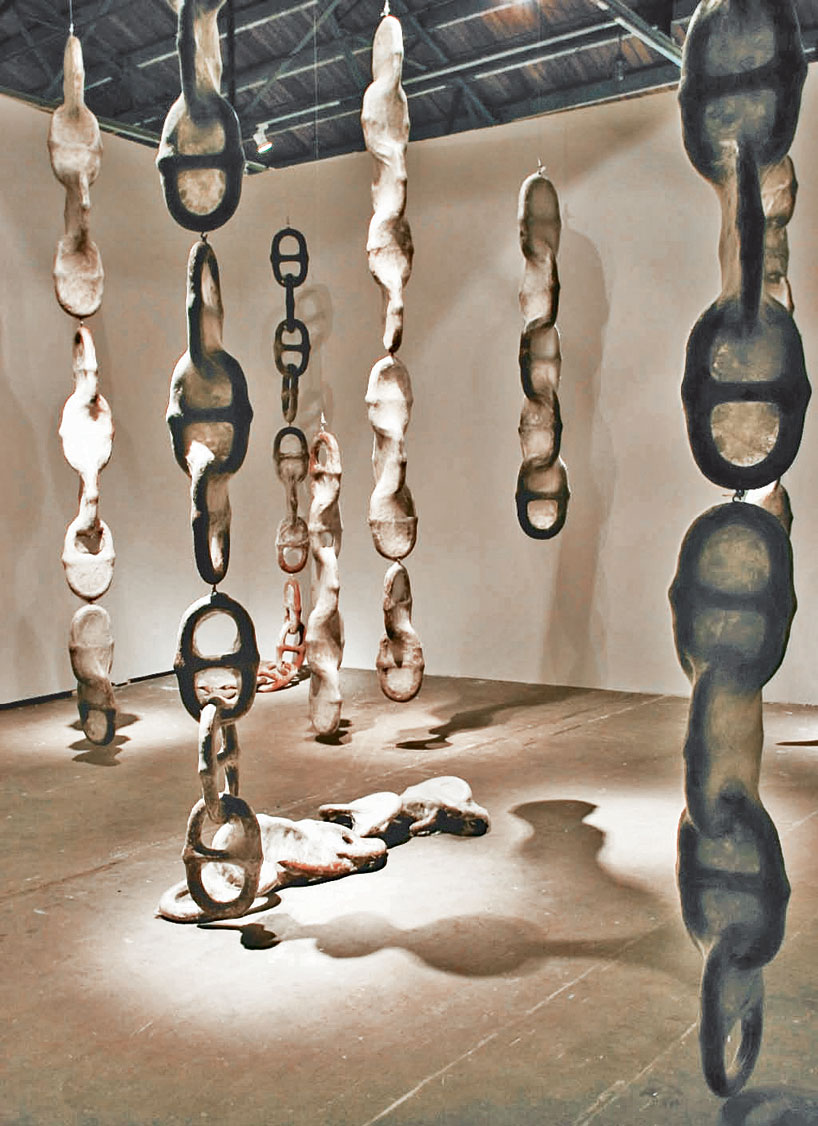
use of silkworm, particularly, spans many references throughout the artwork, not only celebrating through art their phases of life and death, but also the
metaphorical associations attached to the animal - one that represents generosity, its thread denoting history and society. through the narrative of
chinese tradition and this strong symbolic relevance, shaoji poetically articulates the sadness and conflict polluting human life in the purest of raw silk thread.
shaoji offers an ease or a softening of the ubiquitous violence, wrapping the hardness and phlegmatic sterility in an effort to soothe for a compelling
body of work

In an essay on the “Nature Series” that he wrote last year, Liang says: “Every life is in search for its own space for existence amid absurd and implacable contradictions. The strong silk threads, symbol of life, as if to break but resistant, show a strong will to life, an unremitting life pursuit, a force to beat the strong with softness, and life associations with endless extension.”

Thursday, 24 January 2013

razvan boar Razvan Boar’s paintings are wonderful works of art that range between semi abstraction and near photorealism, his images appropriated, from newspapers and magazines perhaps, who knows? What makes them especially appealing to me is his use of muted colours, his palette of black and white with the odd use of judicious colour. With it Boar is somehow able to create an unsettling and unstable mood in his work that draws you in, wants you to know more about his subjects who seem deeply involved in some activity, a sport or something troubling, intangible. Boar, despite his mature paintings is still young – he’s only 30 – and is seen as one of the most promising talents emerging from a new generation of painters in Romania. It has been said about Boar and his work: Superlative painting skills – borne of the same communist era emphasis on traditional techniques that propelled Germany’s Leipzig School to fame – are the hallmark of several recently acclaimed Romanian painters. Razvan Boar seems set to become another. Aside from the obvious virtuosity of his work, Boar’s practice is distinguished by various distancing devices, most of them typical of recent Romanian painting, and each seeking to disrupt the anticipation of narrative raised by keenly observed figuration.


The Collaborative Art of Cara Thayer & Louie Van Patten


Berlinde De Bruyckere

It is not because you never see a head that it looks like it has been cut off. It is, rather, that I no longer think the presence of a head is necessary. The figure as a whole is a mental state. The presence or absence of a head is irrelevant. Berlinde de Bruyckere 
Marthe (2008) shows a body in duality, disgusting but still half-human, a hand found in its twig-like limbs reminiscent of Ovidian-style transformation; it too, despite its lifelike physicality, is sexless, headless, inert, a re-imagined object. “It is not because you never see a head that it looks like it has been cut off. It is, rather, that I no longer think the presence of a head is necessary. The figure as a whole is a mental state. The presence or absence of a head is irrelevant.”

Berndnaut Smilde


Tadao Cern


Ryan Scully