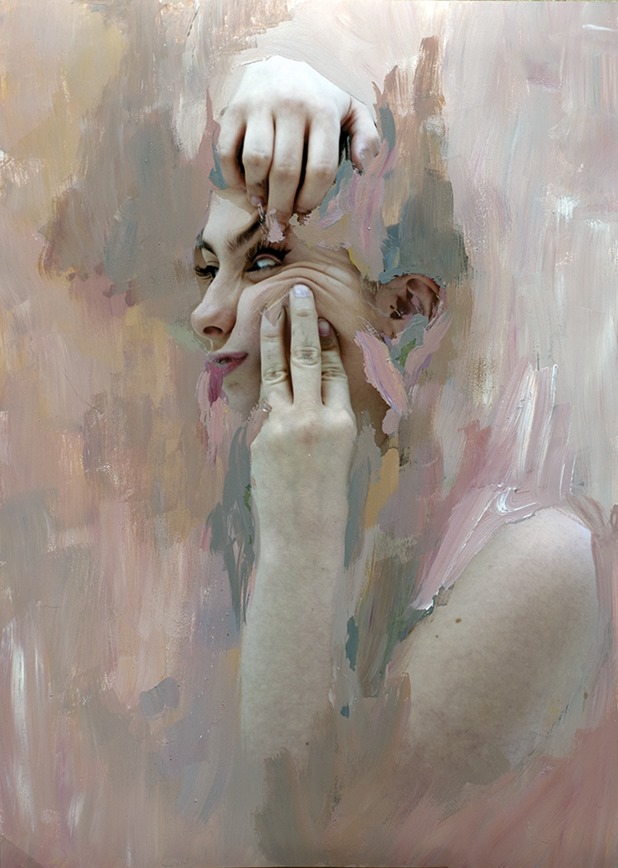
I started my project by manipulating images by painting shades of skin
colour directly onto momentaneous photographs as a way of looking at the
space surrounding the figure. I then took your advice and began
stretching paper and making collages, although I mixed these collages
with different mediums: photograph, drawing with toning, linear drawing,
charcoal, oil paint, and white spirits. Prior to this, I had taken
snaps of Jen (my subject) in her own environment. I have moved away from
the seemingly posed portraits which I used last year. The photos of Jen
were taken as she went about her work and business. I also included
photographs of objects or material surrounding her, as I feel that the
conditions in which we surround ourselves while in such a personal space
such as our bedrooms are very relevant to our personalities.
I
intend to use these collages as a direct inspiration for paintings, and
am interested to see how they translate onto canvas. I don't want these
collages to be in anyway finished pieces. I felt that they were helpful
in terms of composition and planning, as well as experimenting with how
different mediums communicate with one another, which is something I
would like to be continued on canvas/board etc. They were also yet
another "filter" between myself and the finished product (which I
prefer). Another aspect which struck me was the use of negative space
and whether or not it is OK to leave a space empty and why. The collages
proved to be very useful, as they gave me some time to reflect and
judge rather than bowing under the pressure of the finality of paint and
canvas.
Right now in my studio practice I am still taking photographs and making collages to inform my future paintings.
Although
I did enjoy the work of Richard Hamilton, I also don't like things to
be too "perfect". But Hamilton to an extent did use dripping oil paint
in interior II and other works. I am definitely inspired aspects of his
work such as mixing drawing with photographs. Although instead of
photographs I would like to paint imagery as realistic as I can (a
dedicated flower of fashion). He used print processes such as etching
and screen printing mixed with other mediums which is something I would
like to experiment in also. "
In his preparatory study for A dedicated follower of fashion,
Hamilton had blended the separation between the photographic elements
and the markings made by hand. In the print, compositional unity results
from a skilful blending of print techniques on a single plate."


.jpg)
.jpg)