http://www.dazeddigital.com/artsandculture/article/18694/1/how-to-sell-shit-to-women
http://www.dazeddigital.com/artsandculture/article/18662/1/laura-bates-everyday-sexism-how-to-be-woman-online
http://www.dazeddigital.com/artsandculture/article/18432/1/our-ten-favourite-digifeminist-artists
http://www.dazeddigital.com/artsandculture/article/18641/1/the-revolution-will-be-feminised
http://www.dazeddigital.com/artsandculture/article/18013/1/the-best-new-female-fronted-shows
http://kunsthallstavanger.no/en/exhibitions/hold-stenhardt-fast-pa-greia-di

Me, my art, and my travel.
Saturday, 1 February 2014

Kaye Donachie's Malady of Death


 |
| I would apply these colours to highlight the uses in make up artists use today, such as contoring etc. |
Glaswegian-born Donachie's fascination with heroines and literary inspiration runs throughout all her projects along with her subtle nods to romanticism making for a collection that is more "poetic than narrative" in effect. In her most recent exhibition at Maureen Paley, Donachie focused on the female character in Marguerite Duras' French novella The Malady of Death, in which a man pays a woman to stay with him by the seaside and teach him how to love. The ambiguities behind Donachie's brushstrokes create a world that is "part living, part dreaming", she says of the series. "In the paintings the character and the description of time and place drift between dream and reality, as the day passes into night. The paintings and drawings are structured like pages from a book but the play or script denies any linear narrative seeking to express evocative moments in time."
 |
| What I love about this is that her nose is highlighted. I love this idea and would like to apply it to insecurities in my portraits. I need to seriously consider incorporating monochrome into my work |
Friday, 31 January 2014
mirrors in art - Yayoi Kusama
Infinity Mirrored Room In New York By Yayoi Kusama
Japanese artist Yayoi Kusama’s incredible ”Infinity Mirrored Room – The Souls of Millions of Light Years Away” installation at the David Zwirner gallery in New York creates the appearance of endless, near-boundless space. She achieves this effect by creating cubic rooms in which every surface, except the viewer and a small standing platform, is mirrored. Inside the room, hundreds of hanging, flashing, multi-colored LED lights make the observer feel as though they might be standing in a galaxy or a cloud of star dust. Although she has created similar rooms at exhibitions elsewhere, this one was created uniquely for this gallery, which will be on display up until December 21st, 2013.


film by MATT LAMBERT - HEILE GANSJE
This collaboration between Dazed and Channel 4 is a raw depiction of the pains and promiscuity experienced by a group of Berlin youths. The film commands accolade for its nuanced sound editing.
LINK:
<iframe src="http://www.dazeddigital.com/embed/1505" width="640" height="360" frameborder="0" webkitAllowFullScreen allowFullScreen></iframe>
Video idea
I have a few ideas for a few video pieces I would like to try out based on female self identity. There is one in particular that I would like to portray the pressures we women put on each other. I would like to combine the surreal (representing the social media and technology) with the real. The basics: two nude females strip and take blank porcelain masks into their hands (doll type masks, because women these days are constructing themselves with make up Photoshop and Instagram and plastic surgery as a doll maker constructs dolls). They both put the asks on each other but not themselves. They are in a hexagon of mirrors (to be decided, a bit ambitious) and take paint into their hands a face each other and begin to apply different skin colours to the masks to accentuate cheek bones, an evenly sculpted nose, a perfectly symmetrical face the definition of beauty etc. They then take up a marker (or dripping paint? red paint or too morbid?? blue marker like the plastic surgeons? research what marker they use) and begin to mark and circle out areas of "imperfection" as plastic surgeons do pre-op. ending to be decided. maybe the film begins the darkened mirrored room and it slowly fills with light until the end when the results are bared to flood lights and the end result of the two women are revealed.. the the camera smoothly pans out to reveal the interior of a normal suburban house hold. The mirrored room would represent the head space social media have entrapped young women in. The multiple identical figures reflected in the mirrors may reflect how the beauty products and methods today result a similar look applied to alot of girls. Everyone using these products, methods and media filters almost look the same. I like the idea of using text, as I have found alot of online forums where young girls seek help for the low self esteem caused by the physical standards placed on young females by popular media today. Maybe this film would be more effective if it were two young girls rather than two women. I imagine that two women changing their complete appearance would be less shocking than two young girls being so aware of these expectations. BUT they are, as these forums prove.
Here are some video samples that I could draw inspiration from, taken from the magazine Dazed and confused. link : http://www.dazeddigital.com/artsandculture/article/18693/1/our-best-videos
I love everything about this. I love how surreal this is. The text fits in nicely and the last sentenc whispered is very effective. I would like to have the camera smooth and bobbing in my film too. I would enter the house and give the viewer the sense of a normal suburban environment. Then the house would take subtle transformations to represent the inner workings of the mind and would focus on objects representing beauty because this film would be party about the objectification of women after all. the last room would be the room of mirrors. or perhaps I would do it in reverse. I would show snippets of the texts written on these forums or have a young girl read them out. perhaps she would only whisper along to the last piece of text as this in this film.
Here are some video samples that I could draw inspiration from, taken from the magazine Dazed and confused. link : http://www.dazeddigital.com/artsandculture/article/18693/1/our-best-videos
Friday, 17 January 2014
9 Things You Should Know About Female Body Image Issues
9 Things You Should Know About Female Body Image Issues

Gina Pane.... crazy lady
Gina Pane | The Vulnerability of Human Body
From 60’s to 70’s the human body was the core centre of many artists’ research, as both the subject and the object of their work. The body was mainly used as a mean of artistic representation and, simultaneously, as an instrument of inspection of one’s interiority. Through the performance, the Wiener Aktionisten – Hermann Nitsch, Otto Mühl, Günter Brus, Rudolf Schwarzkogler –, and other artists such as Gustav Metzer, Raphael Montanez Ortiz, Yoko Ono, Chris Burden, Vito Acconci and Gina Pane, wanted to break the common taboo and challenged the public policy and morality. Actions were shot and recorded with video, texts and pictures, which served as the evidence of the extreme art experiences.


From 60’s to 70’s the human body was the core centre of many artists’ research, as both the subject and the object of their work. The body was mainly used as a mean of artistic representation and, simultaneously, as an instrument of inspection of one’s interiority. Through the performance, the Wiener Aktionisten – Hermann Nitsch, Otto Mühl, Günter Brus, Rudolf Schwarzkogler –, and other artists such as Gustav Metzer, Raphael Montanez Ortiz, Yoko Ono, Chris Burden, Vito Acconci and Gina Pane, wanted to break the common taboo and challenged the public policy and morality. Actions were shot and recorded with video, texts and pictures, which served as the evidence of the extreme art experiences.
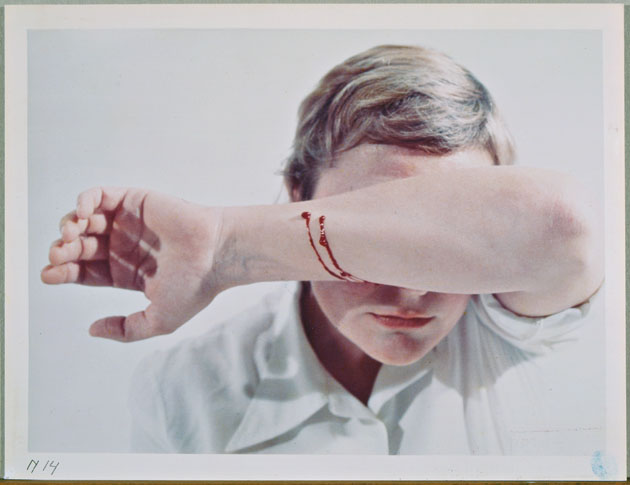
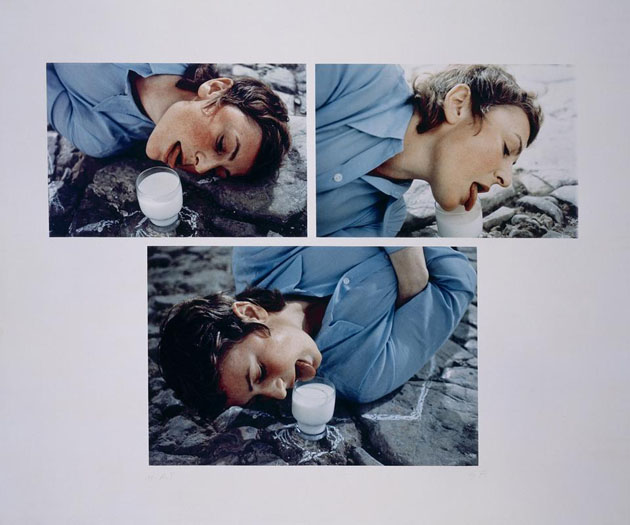
What was really effective in these artworks is the rituality of each act; performances assumed the form of theaters where artists played a sort of a sacrificial comedy focused on their own body. As mentioned above, Gina Pane (1939 – 1990), a French artist of an Italian origin, was one of the main representatives of what is widely recognised as Body Art, the artistic trend characterised by the practise of self-mutilation and sadomasochism. Working with/on her own flesh and blood as an artistic media, Pane laid bare the human body’s fragilities; undressing, hitting, hurting, dirtying her own body, she was able to show the sense of danger and pain.
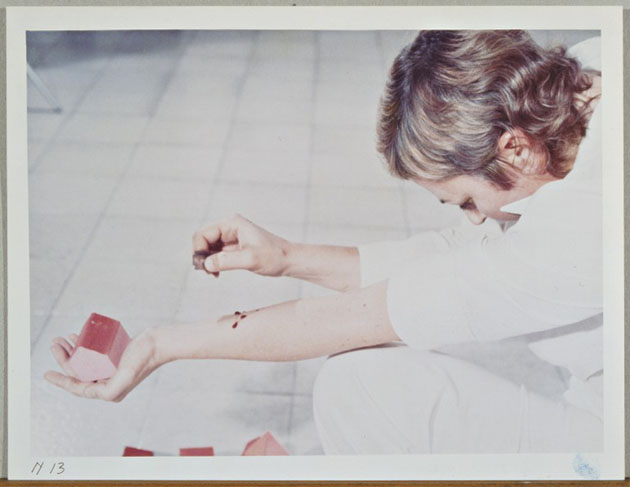
Gina Pane, with a distinctive composure and a rational attitude, used the sufferance as a way of representing spirituality, carrying a deep emotional and symbolic charge. In Sentimental action (1973), the proto feminist artist, dressed totally in white, takes a bunch of roses in her hand and hurts herself with their spines. The blood dripping on the bouquet turns the roses from white to red. At that point, the artist cuts herself with a razor blade.
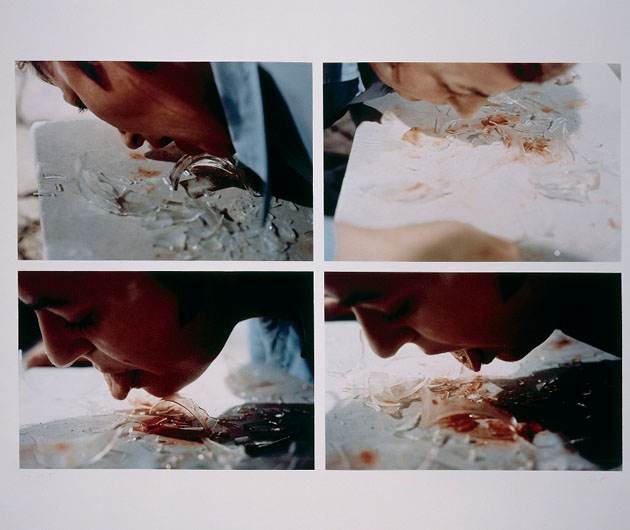
An even higher pathos is represented by Action Psyché (Essai), a performance from 1974 – documented by sketches, photographs, notes – where Gina Pane injures her eyelashes to simulate tears of blood, and then engraves her belly. Some prim viewers could be disarmed and shocked by the narcissism, aggressiveness and exhibitionism displayed in such a rough and direct way.
An anthological exhibition of the great artist entitled Gina Pane – È per amore vostro: l’altro is on view atMart in Rovereto, retracing Gina Pane’s career, from its beginning, through the Actions, getting to the latest works. The show will run until July 8, 2012
Subscribe to:
Posts (Atom)